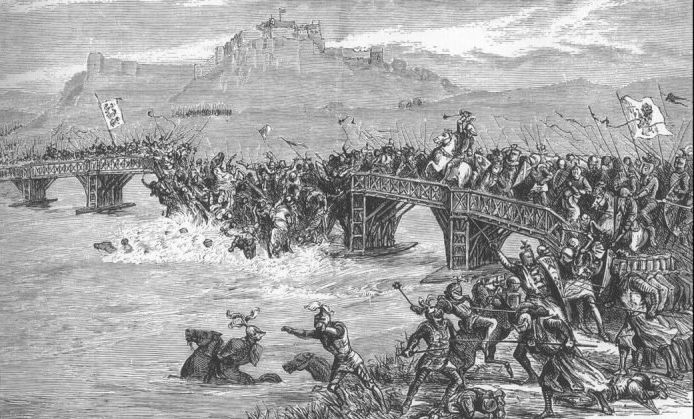
Before talking about the battle itself, I would wish to provide some historical background: William Wallace and Andrew of Moray led the Battle of Stirling Bridge. The truth is that Moray has basically vanished into thin air in the annals of Scottish history, and few people know about him, but you will see that he had decisive leverage in these events. As for William Wallace, I do not think this Scottish hero should need an introduction. You do know about his story, don't you? Or perhaps you know nothing about him. If he is, nowadays, the most famous Scotsman in the world, it is mostly because of Mel Gibson and his movie, Braveheart.
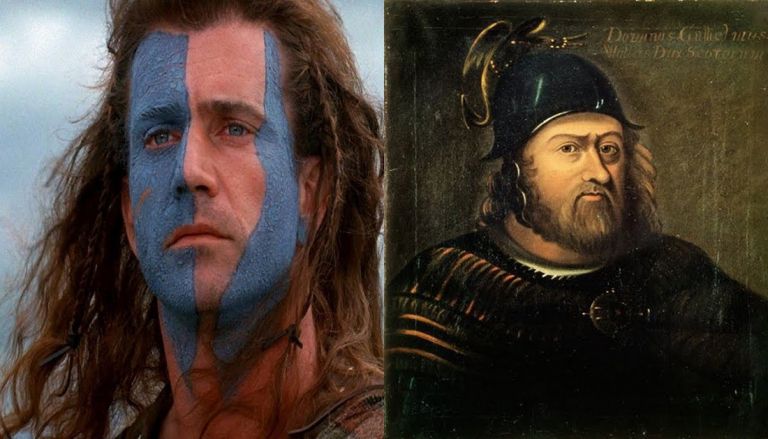
What is factually known about William Wallace, as far as genuine information goes, can be written in a single page. He makes an appearance in several English chronicles, and there is also a document composed by him, bearing his seal, the Lübeck letter (1297). Such a letter was sent to the seafaring harbours of Hamburg and Lübeck, claiming that Scotland was on its way to achieving independence, and that its merchant ports would soon be open. And little more, since everything else which is told about his life comes from an epic poem dating back to 1470, penned by Blind Harry, which is called “The Wallace”. It is no more and no less than a literary creation, full of tropes from knight stories which were typical of those times and, stemming from that epic poem, most biographies that we know about William Wallace would be written in the 1800s.
His father's name is not known for sure, although Sir Malcolm Wallace or Sir Allan Wallace are considered as possible options; nothing is known about his childhood, for that matter, nor about his days as a young man, nor his origins, even though it is believed that he could have been born in Elderslie, near Glasgow. It is also thought that he studied theology, and he might also have fought in the war of Wales, owing to his skills with the sword and the bow. As it has been previously wagered, there is nothing but conjectures and assumptions. And what about Wallace's alleged wife? The truth is that her existence has not been proven at all, since the very first time that she was ever mentioned was on a revised edition of Blind Harry's poem back in 1570. It is also though that Wallace could have been 1.90 meters tall (about 6' 3”), since his sword was 1.65 meters long (around 5' 5”), and it weighed 30 kilos (roughly 66 pounds) so, indeed, he must have been sturdy and tall.
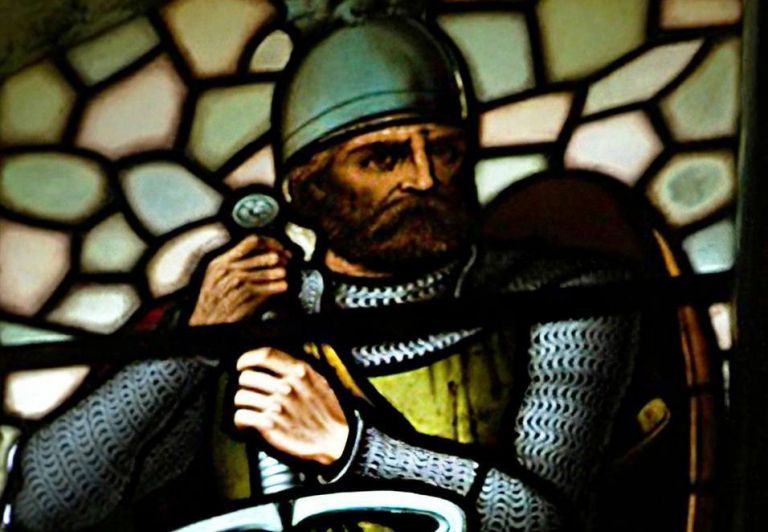
As for Andrew of Moray, although he has been mostly forgotten, there is much more information about him than can be found about William Wallace. He came from a noble family, one of the most influential in Scotland, which had ties to the crown and fought in countless battles. He also rode beside his father during the Battle of Dunbar, against the troops of Edward I, and he spent some time imprisoned in the English town of Chester, but he was able to break free, thus returning to northern Scotland and mustering an army with which he stood up to the English, reclaiming castles such as those in Inverness or Urquhart. Wallace had won over a handful of Scottish noblemen after he murder the sheriff of Lanark, which caused him to lead a group of rebels into southern Scotland. Moray, once he headed southwards, found out about Wallace's activities, hence joining forces, albeit little is known as to how and under which circumstances they met.
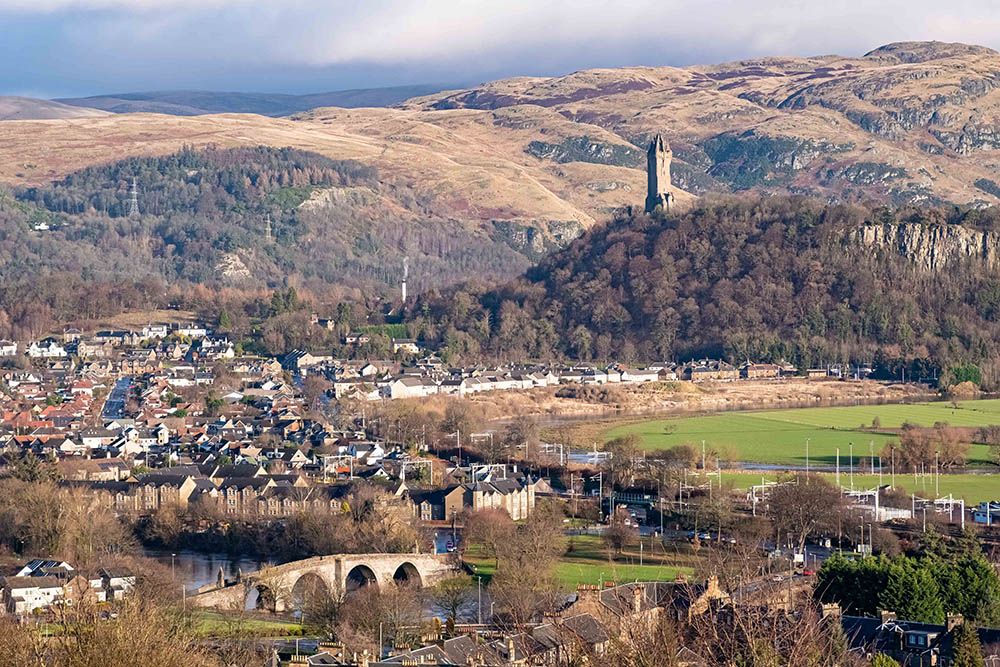
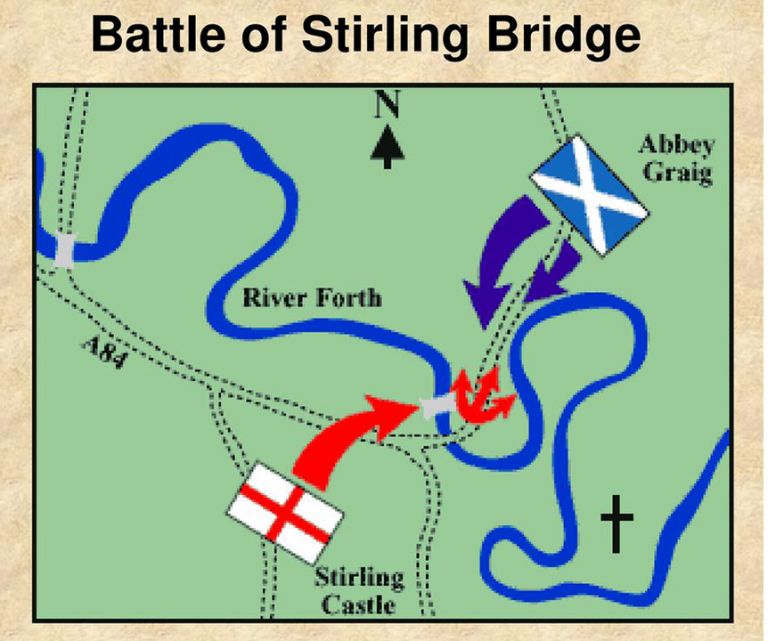
On September 11, year 1297, in the heart of Scotland, Stirling, on the spot where the William Wallace monument stands today, Moray and Wallace could be found, devising the strategy on the day before the attack, a strategy which was conceived by Moray, given that his knowledge in the battlefield was far more extensive than Wallace's.
The Earl of Surrey commanded the English army alongside the royal treasurer, Cressingham. Neither of them regarded the Scots as a threat, since they outnumbered them four to one: 10 000 soldiers, facing 2 500 farmers and peasants. Surrey was a great strategist, and he was acquainted with the codes of chivalry, by means of which the enemy had to wait for them to stand in their formation on the battlefield. This is why they decided to cross the bridge of Stirling with their knights; Moray and Wallace waited for the English horsemen to cross over to bring down the wooden bridge, hence trapping them between the river and the Scottish army, and their archers took care of the rest. Cressingham, the English treasurer, who was fairly hated by the Scots, died in the midst of the battle, and English chronicles tell that the Scotsmen cut him into pieces and shared them; Wallace had a sheath for his sword made with his skin.
Andrew of Moray and William Wallace would be appointed as Guardians of Scotland, although Moray did not last long as a guardian of Scotland, since he would pass away just a few weeks later. There are plenty of contradictions regarding Moray's death, since some historians claim that he died during the very battle, whereas others argue that it happened some weeks later.
Wallace may have been forced to keep sending out documents jointly with the name of his late commander, since he made use of him as a shield against the more elitist and traditional circles in Scotland. Without him, Wallace would be nothing but a former outlaw, and he would be exposed to the political plots of the noblemen. For Wallace, his lasting association with the name of Andrew Moray was a necessity. Only once Wallace had been appointed as a knight and named as a Guardian of Scotland did it become needless to send letters jointly with Moray.
Another interesting fact is that Moray was involved in the only important battle which was won by Wallace; all others were lost. Unfortunately, both cinema and time have forgotten about this hero, since there are no sculptures of Andrew Moray, and the very Scots often ignore who he was, so this may serve as a homage to such an important character as Andrew of Moray was.
Following the Battle of Falkirk, a battle in which Wallace lost his army, he managed to run away to France, where he would stay for 5 years. He went there to muster financial and military support for the Scottish revolt, and also to fight for freedom and independence. And the rest of it is already history. Upon his return to Scotland, he was betrayed by John de Menteith in 1305, and sent to England, where the English put an end to his life...
With the death of William Wallace, the future king of Scotland took over in order to restore Scotland's freedom. It would nearly take a decade before he avenged Wallace's death but, in 1314, following the Battle of Bannockburn, Robert the Bruce would expel the English, and it is here that the path towards independence would begin.
Thanks to the movies, they made us imagine men in skirts and faces painted in blue, they made us dream of cities and incredible landscapes, a country of lovely people, mountains, lakes, monsters, bagpipes and, most importantly: a country with whisky. FREEDOM


